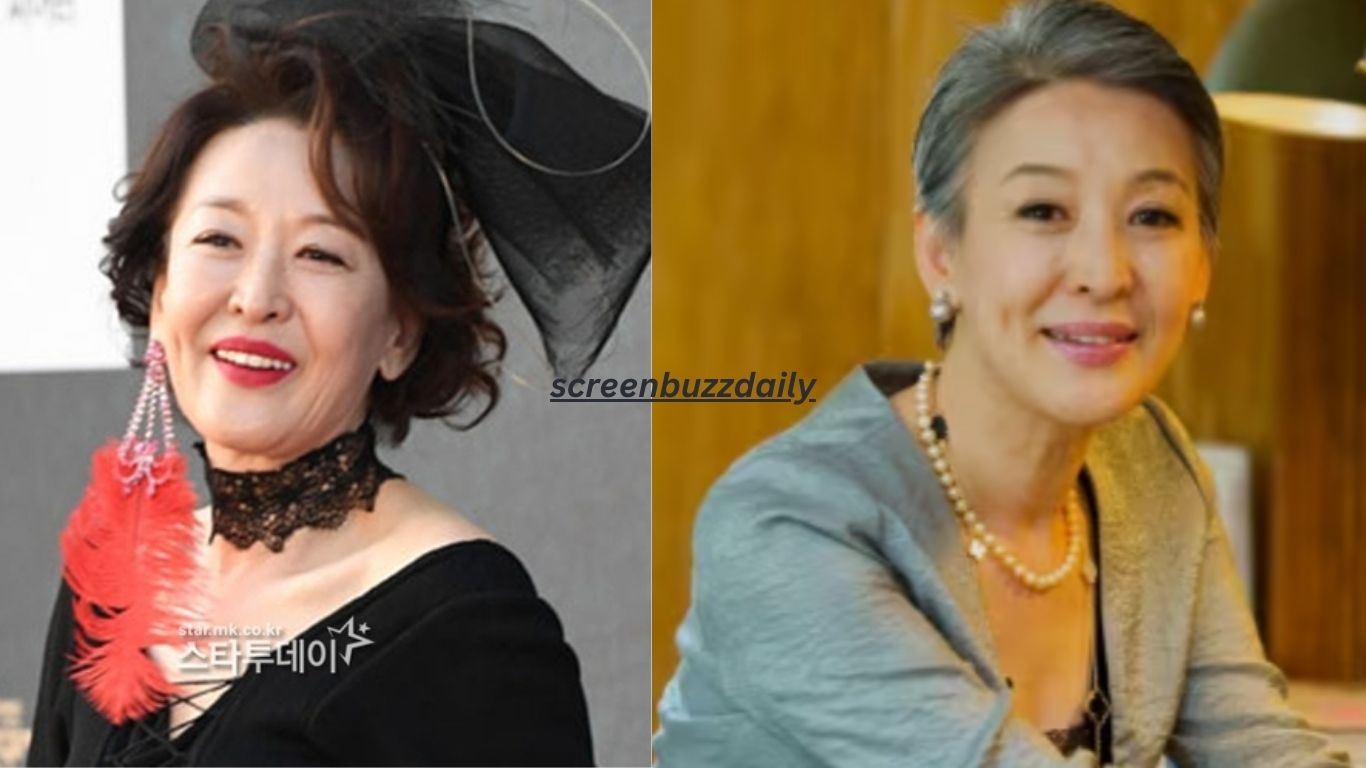
Korean theater legend Yoon Suk-hwa (also romanized Yun Seok-hwa), often called one of the first-generation star stage actresses, has died at the age of 69 after battling a brain tumor.
According to the Korea Association of Theatre Actors, she passed away on the 19th at around 10 a.m. at Sinchon Severance Hospital in Seoul, with her family by her side.
Yoon, who spent more than five decades on stage, became a symbol of passionate acting and artistic integrity. Even while fighting illness, she famously declared, “Even if I live just one day, I want to live as myself,” and hoped to be remembered as “beautiful” on stage.
A Life Lived “As Myself,” Even in the Face of Illness
Yoon Suk-hwa last appeared on stage in July 2022 in a production of “Hamlet.” A few months later, in October 2022, she was diagnosed with a brain tumor.
Refusing to let her illness define her final years, Yoon chose natural therapy over chemotherapy, saying she did not want to lose her sense of self, even if she had only one day left to live.
In a 2023 interview given during her treatment, she said:
“I want to appear on stage one last time with a ‘ta-dah’ before I die for the audience who are waiting for me. I hope someone will remember that, at least on stage, I was beautiful.”
She continued to dream of a full return to the theater. Her final appearance became a brief, roughly five-minute cameo in the play “Toccata” at LG Arts Center Seoul in 2023, a tribute to her senior colleague Son Sook’s 60th debut anniversary. That performance is now regarded as her last work.
From “CM Song Fairy” to First-Generation Stage Star
Born in Seoul in 1956, Yoon Suk-hwa first became widely known not on stage, but through advertising. She was affectionately dubbed the “CM song fairy” (commercial-song fairy) for her memorable voice in commercials such as:
- Soft drink Oren C
- Ice cream Bravo Cone
- Various coffee advertisements
Her husky yet soft voice captivated the public, and a now-famous coffee commercial line, “I may seem tough, but I’m actually a soft woman,” became a catchphrase.
Yoon made her stage debut in 1975 with the play “Honey Taste” (Kkulmat), but it was nearly a decade later that she exploded into stardom.
Iconic Roles That Redefined Korean Theater
Yoon’s breakthrough came in 1983 with the play “Agnes of God” (Korean title: “Shin-ui Agnes”). Playing Agnes, a young nun accused of killing her newborn child, she delivered a raw and emotionally intense performance that stunned both critics and audiences.
- The production ran for about 10 months, then a record-length engagement.
- It drew an estimated 60,000 audience members, a remarkable achievement for the time.
- The role cemented her status as the first true mainstream star of the Korean stage.
She continued to dominate the theater scene with a series of major roles, including:
- “Letter to a Daughter” (1992) – playing jazz singer Melanie, showing her vocal and dramatic range.
- “Master Class” (1998) – transforming into legendary soprano Maria Callas, capturing both the diva’s grandeur and fragility.
- “Three Sisters” (2000) – starring in Anton Chekhov’s classic alongside Park Jung-ja and Son Sook, a landmark production often cited as opening a new era for women-led theater in Korea.
Yoon also made memorable turns in musical theater:
- “Guys and Dolls” (1994) – as showgirl Adelaide, she balanced comedy and pathos with charisma.
- “The Last Empress” (1995) – portraying Empress Myeongseong, she brought tragic dignity and emotional depth to one of Korea’s most famous historical figures.
These roles helped define modern Korean theater acting, blending classical technique with emotional realism.
Beyond Acting: Director, Producer and Arts Patron
Yoon Suk-hwa’s passion for the stage extended far beyond acting. She became a director, producer, entrepreneur and arts patron, shaping the theater ecosystem itself.
Director and Producer
- In 2003, she directed the musical “Saturday Night Fever” (Korean production), starring actors like Choi Jung-won and Park Geon-hyeong.
- The show earned her the Korea Musical Awards Director Prize the following year.
- She later took part in producing the musical “Top Hat,” which went on to win Best New Musical at the prestigious Laurence Olivier Awards in the UK.
Cultural Entrepreneur
- In 1994, she founded the entertainment company Dolkkot Company (literally “Stone Flower Company”), a comprehensive entertainment and production house.
- Under this label she produced the animated film “Hong Gil-dong 95.”
- In 1999, she acquired the struggling performing-arts monthly magazine “Gakseok (Auditorium)”, serving as publisher until 2013 to keep a vital arts journal alive.
Nurturing the Next Generation
From 2002 to 2020, Yoon operated the small theater “Jeongmiso” in Seoul’s Daehak-ro district, the heart of Korean theater.
- Jeongmiso became a platform for younger and independent theater artists, where emerging actors and experimental works could find a home.
- Her commitment helped foster a more diverse and sustainable theater community.
Over her career, she received major honors, including:
- Four Baeksang Arts Awards for Best Actress
- Recognition from the Dong-A Theatre Awards, Seoul Theatre Festival, and the Lee Hae-rang Theatre Award, among others.
Champion of Adoption and Social Change
Beyond the arts, Yoon Suk-hwa was an outspoken advocate for adoption in a society where bloodline and traditional family structures are deeply emphasized.
- She adopted a son in 2003 and a daughter in 2007.
- She served as an adoption ambassador, working to shift public attitudes and make adoption more accepted and visible in Korea.
- In 2005, she received a Presidential Citation for her contributions to promoting adoption culture and challenging Korea’s closed family norms.
Her life offstage reflected the same courage and conviction she showed in her roles.
Mourners Pay Tribute at Seoul Funeral
At the funeral hall set up at Sinchon Severance Hospital, a steady stream of mourners from the theater and cultural worlds came to pay their respects.
Colleagues from “Hamlet”
Director Son Jin-chek, who directed Yoon’s final full production, “Hamlet,” recalled:
“During ‘Hamlet’ she would sometimes say she was tired, but I never imagined that was the beginning of her illness. She was the first star of Korean theater. It’s heartbreaking that she left before fully unfolding all of her talent. She must feel regretful, and so do we. It feels like we’ll meet again soon to work on a good production.”
His wife, actress Kim Sung-nyeo, who had worked with Yoon since their Minjung Theatre Company days, said:
“I keep thinking that what she couldn’t achieve, we who remain must achieve on her behalf. I hope she goes ahead of us to heaven, forms a theater troupe there, and that someday we can join her and act together again.”
Former Culture Minister and actor Yoo In-chon, who shared the stage with her in “Hamlet,” said:
“She still had so much to do for the theater world. My heart aches and I am deeply saddened. I believe Yoon Suk-hwa will remain in many people’s hearts just as she was. She repeatedly told me from her hospital bed that once she recovered, she wanted us to work on a new piece together. I hope she can now dream and create many good works in a place free from all constraints.”
Tributes from the Cultural Community
Current Culture, Sports and Tourism Minister Choi Hwi-young also visited the funeral hall:
“Yoon Suk-hwa was a great pillar of the theater world, and on stage she burned the brightest. Even while fighting illness, she never let go of her longing for the stage. It is heartbreaking that she has left us so soon. We will remember her forever.”
Actress Park Jung-ja, a close friend and long-time collaborator, stayed by the family’s side, personally welcoming mourners.
Inside the funeral hall, a 1-hour-20-minute documentary played continuously, showing:
- Yoon’s most powerful stage moments
- Scenes of colleagues supporting and encouraging her during her illness
The documentary was produced by Lee Jong-il, former head of Minjung Theatre Company, who has worked with her since 1985. He reflected:
“She said she hoped to be remembered as the most beautiful actor on stage, and I agree with that completely. Her passion and dedication were unmatched. Even after choosing natural treatment and fighting from home, she never lost her positive spirit.”
Many in the arts community came or sent wreaths, including:
- Actors Son Sook, Kang Seok-woo, Gil Hae-yeon (chair of the Korea Theatre Artists Welfare Foundation)
- Singer Yoo Yeol, Lee Moon-sae
- Actors Go Doo-shim, Choi Jung-won, Nam Kyung-joo, Song Seung-hwan
- Jung Byung-guk, chair of the Korea Arts Council
- Cellist and professor Yang Sung-won of Yonsei University
Singer Yoo Yeol, who had a particularly close relationship with Yoon, remembered:
“Right after I debuted through the 1986 college music festival, she invited me to many of her performances, so I saw a lot of her plays. Two years ago, when I was very ill and gave a testimony at a small church, she heard about it and came to see me. She was such a warm person.”
Funeral and Final Resting Place
- Funeral (발인): Scheduled for the 21st at 9 a.m.
- Memorial Rite (노제): At 10 a.m. the same day in Daehak-ro, at Hanye Theater, located where Yoon’s beloved small theater Jeongmiso once stood. The ceremony, organized by the Korea Theatre Artists Welfare Foundation, will last about 20 minutes.
- Burial Site: Yongin Park Honor Stone (Yongin Park Honors Stone Cemetery).
Yoon is survived by:
- Her husband, Kim Seok-ki, former CEO of JoongAng Comprehensive Finance
- Her son, Kim Su-min
- Her daughter, Kim Su-hwa
An Enduring Legacy on the Korean Stage
From commercial jingles to groundbreaking plays, from leading roles to directing, producing and nurturing new talent, Yoon Suk-hwa’s life traced the evolution of modern Korean theater itself.
She insisted on living and acting “as herself,” refusing to surrender her identity even when illness threatened her life. She wanted to be remembered as “beautiful on stage” — not in a superficial sense, but in the depth, honesty and intensity of her performances.
For countless theatergoers, colleagues and younger artists, she already is.
Her name, her voice, and her presence will endure wherever Korean theater is remembered and performed.