The Korean film “The Great Flood” on Netflix looks, at first glance, like a large‑scale disaster movie. The title suggests global catastrophe, visual spectacle, and survival at any cost.
But according to Korean media coverage and commentary, the film is in fact a deeply emotional story about maternal love, set against a science‑fiction backdrop. It has already proven its global appeal: after its release on the 19th (local time), the movie surpassed 27.9 million views and reached No. 1 in Netflix’s non‑English film category.
This review focuses on verified details while exploring why “The Great Flood” is resonating with viewers around the world.
At a Glance: Key Facts About The Great Flood
- Title: The Great Flood (대홍수)
- Platform: Netflix
- Country / Language: South Korea / Korean
- Genre: Sci‑fi, disaster, drama
- Director: Kim Byung‑woo
- Main Cast: Kim Da‑mi, Park Hae‑soo
- Global Performance (reported):
- Over 27.9 million views shortly after release
- Ranked No. 1 in Netflix’s global non‑English film category in that period
Plot Overview (Spoiler‑Light)
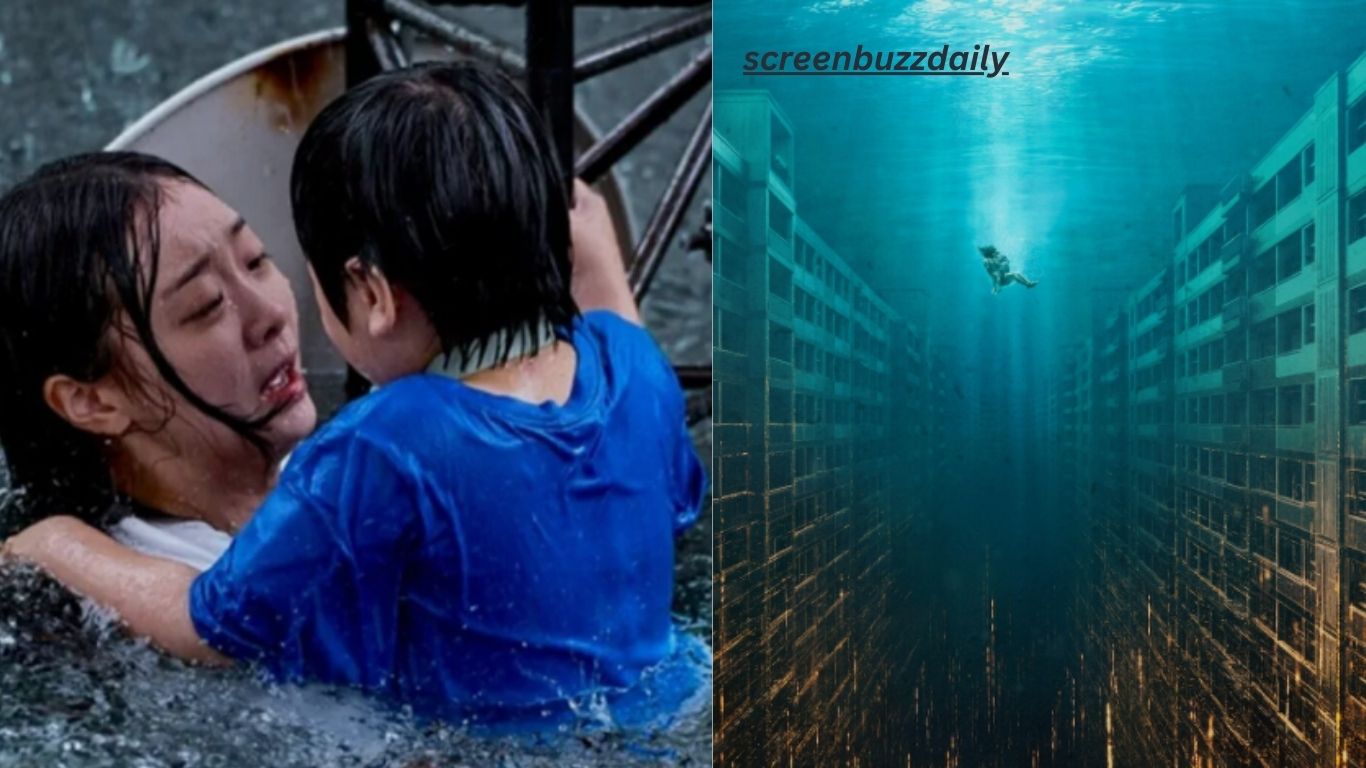
On the surface, The Great Flood is set in a post‑apocalyptic world where a massive global flood has wiped out existing humanity. Only a small number of survivors remain, tasked with creating a “new humanity” from the ruins.
At the center of that mission is Anna, the protagonist:
- Anna is the only engineer capable of creating a core technology called the “Emotion Engine.”
- She has already succeeded in building an Emotion Engine for children.
- A 6‑year‑old child named Ja‑in, equipped with this completed child Emotion Engine, has lived with Anna for several years as part of this new‑humanity project.
Anna’s next, and most difficult, assignment is very specific:
She must complete an Emotion Engine for mothers.
This raises the central dramatic question of the film:
How can someone who has never given birth create a “mother’s” emotional core?
The story follows Anna as she struggles to answer this question through a series of intense, repeated experiments rooted in loss, empathy, and ultimately, love.
A Disaster Film That’s Really About Maternal Love
Although marketed and titled like a disaster movie, The Great Flood is structured around a more intimate question:
“Where do the beginning and the end of maternal love lie?”
To explore this, director Kim Byung‑woo uses the aftermath of a global flood as a kind of “reset” for the world. The familiar structures of society are gone, leaving space to examine one essential human emotion: maternal love.
The Core Experiment: A Mother Searching for Her Lost Son
To build the mother’s Emotion Engine, Anna repeatedly runs a key experiment:
- She recreates a scenario from the great flood she herself experienced.
- In this recreated world, a mother loses her son during the disaster.
- The experiment requires that the mother must find her son again.
At the beginning:
- Anna cannot even understand Ja‑in’s language, despite the fact that he is crucial to the experiment.
- The process is filled with repetition, failure, and trial and error—described as tens of thousands of attempts.
Over time, Anna moves beyond formulas and data. Through countless iterations:
- She begins to understand her son’s heart “with her whole being.”
- She learns to read Ja‑in’s emotions, needs, and signals—not just as a subject, but as a child.
- In doing so, she finally completes the mother’s Emotion Engine.
This journey is not presented as a clean, triumphant arc. It involves harsh choices, emotional responsibility, and recurring pain—elements that Korean commentary explicitly likens to the everyday reality of ordinary mothers in the real world.
Characters and Performances at the Center
Anna: Engineer, Caregiver, and Reluctant “Mother”
Anna’s role is technically defined—she is an engineer building emotional software for a new human race. But the film’s central conflict pushes her beyond professional expertise:
- She begins as a designer of feelings.
- She is forced to become a participant in those feelings.
- The project to create a “mother’s emotion” gradually transforms her into someone who must live that emotion.
Her decisions throughout the experiment, and the consequences she must endure, are core to the narrative. According to Korean press analysis, her experiences mirror those of “ordinary mothers” who continually make difficult choices for their children and bear the emotional cost.
Ja‑in: Child, Subject, and Emotional Mirror
Ja‑in, the 6‑year‑old equipped with the child Emotion Engine, is more than a test model:
- He represents both the future of humanity and the immediate emotional challenge Anna must face.
- At first, even his language is incomprehensible to Anna, symbolizing the real‑world gap many adults feel when trying to understand a child’s inner world.
- Over the course of the film, he becomes the mirror through which Anna learns what maternal love truly requires.
Themes: Maternal Love as the Core of Humanity
One of the film’s most striking conceptual claims—highlighted clearly in Korean commentary—is this:
If there is one trait the new humanity must possess, it is maternal love.
This does not simply mean biological motherhood. Instead, the movie treats “maternal love” as a symbol for essential human qualities, such as:
- Deep empathy
- Willingness to sacrifice
- Taking responsibility for another life
- Continuing to care despite pain and repetition
The Emotion Engine becomes a metaphor:
- On the surface, it is a technology to encode emotions.
- At a deeper level, it is a tool that forces Anna—and the audience—to question whether something as profound as love can be engineered at all.
The film suggests that while technology can simulate or support feelings, true maternal love is something that must be lived and suffered through, not merely programmed.
The Sci‑Fi Setting: A Clean Slate for Humanism
According to the Korean analysis, the science‑fiction framework does not exist to mislead the audience into expecting only spectacle. Instead, it serves a very deliberate function:
- The global flood resets the world to zero.
- Social structures, cultural backgrounds, and everyday distractions are stripped away.
- In that stripped‑down world, “humanism”—especially the question of what makes us truly human—stands out more sharply.
By isolating Anna, Ja‑in, and a small group of survivors in this post‑flood setting, the film can focus squarely on:
- What maternal love looks like under extreme conditions
- How far a person must go to truly understand another’s heart
- Which emotional traits are non‑negotiable for any human future
In this sense, The Great Flood is less about the disaster itself and more about the values that must survive after the disaster.
Why The Great Flood Stands Out on Netflix
Several factors help explain why The Great Flood quickly climbed to the top of Netflix’s non‑English film rankings:
- Global Accessibility of Its Theme
Maternal love and the struggle to understand one’s child are universal experiences, transcending language and culture. - Blend of Genre and Emotion
The movie combines the visual and conceptual appeal of sci‑fi and disaster settings with a character‑driven emotional story, which appeals to viewers seeking more than spectacle. - Star Power and Growing Trust in K‑Content
With Kim Da‑mi and Park Hae‑soo in leading roles, and backed by the current global interest in Korean series and films on OTT platforms, the film benefits from strong initial curiosity and word‑of‑mouth.
Who Should Watch The Great Flood on Netflix?
You may find The Great Flood particularly engaging if you:
- Enjoy sci‑fi and disaster films that prioritize emotional depth over nonstop action
- Are interested in stories about motherhood, parenting, or care under extreme circumstances
- Like Korean dramas and films that explore intense human emotions in high‑concept settings
- Prefer thought‑provoking narratives that raise ethical and philosophical questions rather than offering simple answers
If you go in expecting only large‑scale destruction and survival scenes, you may be surprised. The film uses its disaster setting primarily as a stage for a very specific emotional journey, rather than as the main attraction.
Final Thoughts: A Flood That Reveals What Must Remain
Despite its title, The Great Flood is not just about water, ruins, or the end of the old world. It is about:
- What must not be lost, even when everything else is washed away
- How maternal love—complex, painful, and often misunderstood—can be seen as the core of human identity
- Why new humanity, if it is to be worthy of the name, needs more than technology and survival skills; it needs real, lived empathy
By starting from a seemingly familiar disaster premise and then drilling down into the relentless pursuit of a mother’s heart, director Kim Byung‑woo delivers a film that is both conceptually intriguing and emotionally resonant.
For viewers looking for a professional, well‑crafted Korean sci‑fi drama that asks serious questions about love, humanity, and the future, “The Great Flood” on Netflix is well worth your time.