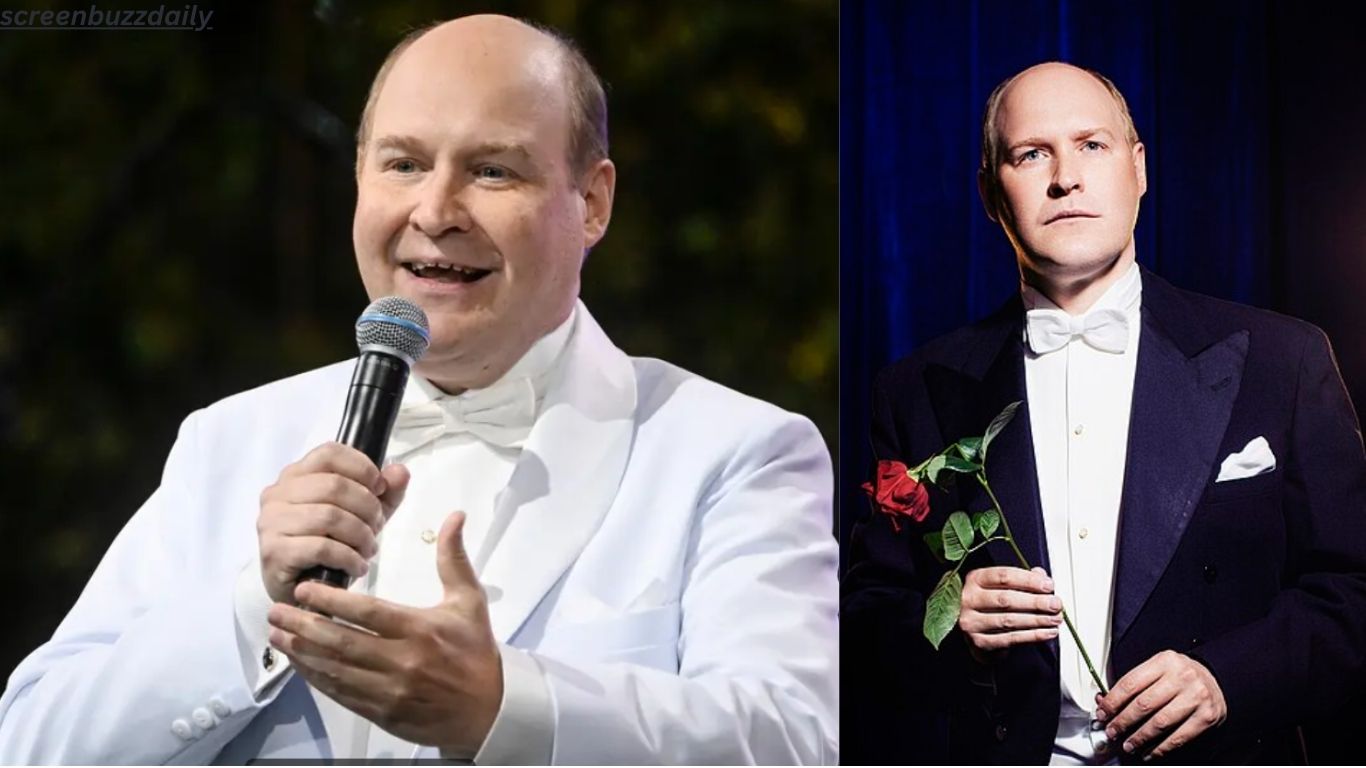
Henrik Dorsin was born Per Henrik Dorsin on November 20, 1977, on Lidingö in Stockholm (Sweden). His story starts with migration and identity, because his grandfather was a Polish immigrant. That background later helped shape his eye for social behavior and belonging.
His family’s original surname was Dziewior, but in the 1950s it was changed to “Dorsin” because many Swedes could not pronounce the old name. That feeling of being seen as an outsider sometimes shows up in his more serious satire and character work.
“Born a gubbe”: early tastes and early performing
Dorsin has described himself as “born a gubbe,” meaning he felt like an old man even as a child. Instead of following 1980s pop trends, he collected old shellac records and studied Swedish revue legends like Karl Gerhard and Povel Ramel.
His first big “stage” was school. In primary school he performed in “Roliga timmen” (Funny Hour) and took it unusually seriously, almost like a real job. That early discipline is a key detail in how he later became both a performer and a creator.
Swedish comedian, actor, and writer / screenwriter
Henrik Dorsin is widely seen as a Swedish comedian who also works as an actor, writer / screenwriter, singer, and theatre director. What makes him stand out is how he blends classic Swedish variety traditions with modern sketch comedy and political satire.
Instead of a traditional acting school path, he studied screenwriting at the Institute for Higher TV Education (IHTV) in Gothenburg. That training helped him build strong comedic structures, not just deliver jokes, and it explains why his projects often feel like full “worlds.”
Grotesco: ensemble comedy and daring satire
In 2006, Dorsin and childhood friends—including Michael Lindgren and Erik Wernquist—entered SVT’s competition Humorlabbet. Their entry “Grotesco Royal” won, and that victory led directly to the Grotesco television series. It became a major example of ensemble comedy in Sweden.
Grotesco also brought controversy. In 2009, the group performed “Tingeling” during Melodifestivalen, using Russian stereotypes in a way that caused a formal protest from the Russian Embassy. The moment showed how quickly satire can collide with real-world politics.
Flyktingkrisen – en musikal and international recognition
In 2017, Grotesco produced Flyktingkrisen – en musikal, an uncomfortable satire about Sweden’s changing political stance on refugees. The project was designed to provoke debate, not comfort, and it captured a tense moment in the Swedish comedy scene.
The impact was not only local. The production won the international Rose d’Or in 2018, a major recognition for television and entertainment. For Henrik Dorsin, it confirmed that Swedish satire—when sharply written—can travel beyond Sweden’s borders.
Solsidan and the Ove Sundberg (character) phenomenon
For many viewers, Henrik Dorsin became a household name through Solsidan (2010–present). His character roles reached a new level with Ove Sundberg, a stingy, socially unaware neighbor who borrows things and never returns them. The character is both painful and funny.
Ove’s cultural impact is huge in Sweden. “Ove” became shorthand for someone overly cheap or intrusive. Dorsin later played Ove in the Swedish version of The Office (Kontoret), making him notable for carrying the same character across two different hit franchises.
Stage performer / theatre: Scalateatern and Swedish revue tradition
In 2014, Dorsin made a major move in the entertainment industry (Sweden) by becoming co-owner and director of Scalateatern, a historic theatre in Stockholm. His goal was clear: protect the Swedish revue tradition—satirical sketches mixed with musical numbers—from fading away.
His work at Scala proved popular. Scalarevyn (2020–2022) blended high-brow opera with low-brow slapstick, showing his love for contrast and timing. He is also involved in Svenska revyn (2024–2025) with Johan Glans and Vanna Rosenberg.
Film actor breakthrough: Triangle of Sadness
In 2022, Henrik Dorsin gained wider international attention in Ruben Östlund’s Triangle of Sadness, which won the Palme d’Or. This film actor role introduced him to many viewers who did not know his Swedish TV and theatre background.
He played Jarmo, a lonely and extremely wealthy tech billionaire. Reviews often noted the tragicomic tone of the performance—funny on the surface, but sad underneath—showing Dorsin’s range beyond sketch comedy and into deeper character study.
TV personality, awards, and national recognition
Dorsin’s status as a TV personality and performer is backed by major honors. He received the Karamelodiktstipendiet in 2007 for linguistic wit, recognizing how carefully he uses words and rhythm. That award fits a comedian who builds humor through language, not only faces and noise.
He also served as SVT Christmas Host in 2014, a role seen as a national honor in Sweden. He won Kristallen awards for Best Male Actor (2014 and 2018). In 2025, he received Natur & Kulturs Kulturpris, worth 500,000 SEK.
Personal life, “hyfs,” and the introvert behind the stage
Henrik Dorsin is married to actress Hanna Dorsin, who is also connected to Grotesco. They have two sons, Frank (born 2005) and Sigge (born 2009). Frank became known as a child actor, including for a role in Bonusfamiljen.
Despite his loud stage image, Dorsin is known as shy and introverted in private and has spoken about performance anxiety and the pressure to be “always funny.” A key theme in his work is “hyfs,” a Swedish idea of decency and good manners.
Henrik Dorsin’s place in the Swedish comedy scene
Henrik Dorsin’s career makes sense when you see the full picture: a Stockholm-based performer with Polish-rooted family history, a screenwriter’s structure, and a stage performer’s love for tradition. From Grotesco to Solsidan to Scalateatern, he keeps Swedish satire both classic and current.